
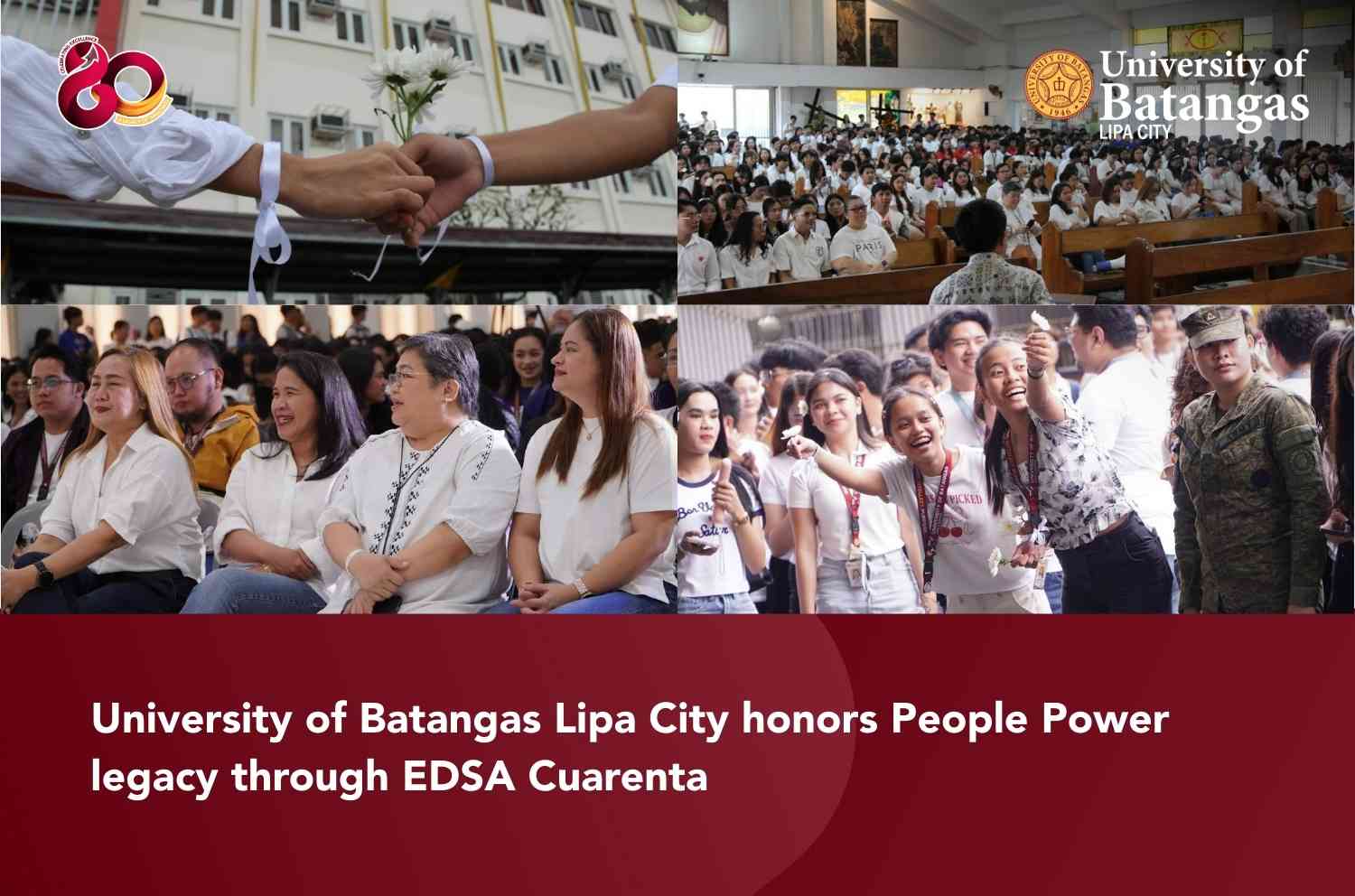
The University of Batangas Lipa City (UBLC) commemorated the 40th anniversary of the 1986 EDSA People Power Revolution on February 25, 2026, through “EDSA Cuarenta: Isang Pag-alaala,” a campus-wide initiative that gathered administrators, faculty members, employees, and students in reflection, dialogue, and prayer to honor the peaceful uprising that restored democracy in the Philippines.
The EDSA People Power Revolution, held from February 22 to 25, 1986, was a series of largely peaceful demonstrations in Metro Manila that led to the departure of Ferdinand Marcos Sr., ended his 20-year rule, and reinstated democratic institutions in the country. The movement emerged from sustained civil resistance against electoral fraud, regime violence, and suppression of freedoms, ultimately becoming one of the most significant nonviolent revolutions in modern history.
In observance of the anniversary, UBLC transformed its campus into a space of historical remembrance and civic engagement. Nationalistic songs related to the revolution were played simultaneously through speakers positioned at the façade of Building A, the gymnasium, and the Building C lobby. Documentaries and films about the People Power Revolution were shown on television screens across campus lobbies, providing historical context and encouraging reflection among UBians.
Anchored on the university’s core value of love of wisdom, the highlight of the commemoration was “EDSA Cuarenta: Isang Pag-alaala – Lightning Talks”, inspired by the format of TED Talks. Three invited speakers each delivered 15-minute discussions examining the historical, civic, and institutional relevance of EDSA.
Mr. Abvic Ryan C. Maghirang, Alumni Relations Officer of the University of Batangas, presented “Historical context and global impact of EDSA People Power.” He discussed the political climate during the final years of martial law and emphasized that while EDSA restored democratic structures, it did not automatically resolve deep-rooted social and economic inequalities. He concluded by posing a critical question to the audience: “Was EDSA a success?” The question invited students to evaluate the revolution as a historic triumph and as an ongoing democratic responsibility.
Representing the youth sector, Hon. Jed D. Magsino, SK Chairman of Barangay Bulacnin and District Deputy Director of the SK Federation of Lipa City, delivered a talk on “The role of the youth in nation-building amid current social and political issues.” He opened with a thought-provoking question: “What if EDSA happened today?” Magsino challenged students to consider how social media would influence civic mobilization and whether today’s generation would demonstrate the same courage and unity shown in 1986. He underscored the power and responsibility of digital platforms in shaping political awareness, warning that the same tools that can mobilize truth can also spread misinformation.
Providing institutional integration, Atty. Ezekiel Mostiero, faculty member of the College of Education, Arts, and Sciences, discussed “Connecting EDSA’s legacy to the University’s core values.” He emphasized that remembrance must translate into ethical leadership, critical thinking, and responsible citizenship. According to Mostiero, universities serve not only as centers of instruction but also as training grounds for democratic participation, where students learn to question, discern truth, and uphold accountability. He highlighted that the preservation of democracy depends on citizens who value integrity, justice, and informed engagement.
The commemoration extended beyond lectures through the conduct of “Lakad ng Pagbalik at Pagtanaw”, mirroring the spirit of collective action during the 1986 uprising. Participants walked from the Multipurpose Hall to Building C and exited the campus toward Leviste Highway, proceeding to Sto. Niño Parish of Marauoy, Lipa City, for a communal prayer. The symbolic walk emphasized peaceful solidarity and shared responsibility in safeguarding democratic institutions.
In an interview, Student Government President Anne Marjorie M. Caringal stated that the activity serves as a reminder that “power resides in the people.” She stressed that democracy functions when citizens remain vigilant and accountable, recognizing that those elected to public office derive authority from the electorate.
Faith, a defining element of the 1986 revolution, was also highlighted during the observance. During the 1986 uprising, then Manila Archbishop Jaime Sin called on civilians to protect reformist soldiers, a moment that galvanized peaceful mass participation. In a recent reflection shared in an interview with The Religion Reporter, Lingayen-Dagupan Archbishop Socrates Villegas recalled the tense final days of the revolution and the fear of potential violence. He quoted Cardinal Sin’s calm assurance: “Our Blessed Mother will not allow bloodshed,” underscoring the deep spiritual dimension that shaped the movement.
In solidarity with that legacy, the university community offered “Panalangin ng Pag-asa Para sa Masa”, praying 40 Hail Marys – each prayer symbolizing one year since 1986 and each intention entrusted to the Filipino people. The solemn offering reinforced the role of faith in sustaining hope and unity during periods of political uncertainty.
As misinformation and historical distortion continue to challenge public discourse, UBLC emphasized that commemorating EDSA is not merely an act of nostalgia but a reaffirmation of democratic principles. The university underscored that the revolution stands as a reminder of the sacrifices made to restore freedom, the responsibility of the present generation to protect it, and the enduring truth that democracy thrives only when citizens remain informed, critical, and engaged.
Forty years after EDSA, the University of Batangas Lipa City affirms that remembrance is an active duty. Through dialogue, education, civic participation, and prayer, the institution continues to uphold the values that shaped one of the most defining moments in Philippine history – proving that the legacy of People Power endures not only in memory, but in action.