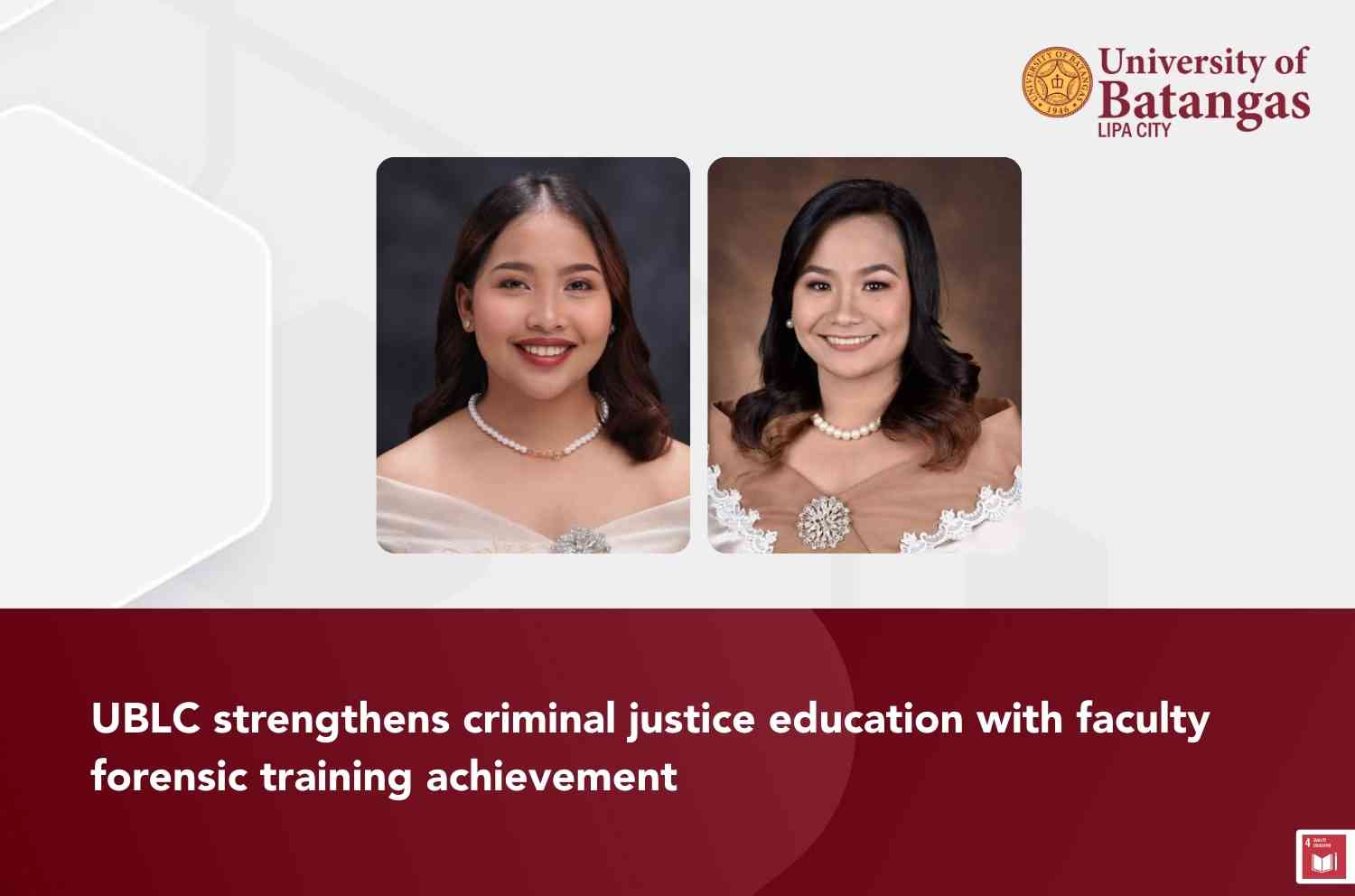
Two faculty members from the College of Criminal Justice Education of the University of Batangas Lipa City successfully completed the Forensic Science Certification Training Course (FSCTC) conducted by the Forensic Science Practitioners of the Philippines, Inc. (FSPPI) from December 18 to 20, 2025, at Ignacio A. Peckley Sr. Hall, Upper Lamtang, La Trinidad, Benguet.
Ms. Angelica Arianne C. Castillo and Ms. Maria Lea S. Delfin participated in the intensive training, earning key professional forensic science certifications designed to enhance academic rigor and practical expertise within the field of criminal justice education. Castillo completed certifications as a Certified Forensic Photography Practitioner (CFPP), Certified Forensic Ballistics Practitioner (CFBP), and Certified Laboratory Custodian Practitioner (CLCP), while Delfin obtained certifications as a CFPP and CFBP.
The Forensic Science Certification Training Course, offered by the Forensic Science Practitioners of the Philippines, Inc., is part of the organization’s mission to enhance the competencies of forensic professionals, supporting truth and justice through specialized training and continuing professional development (CPD). FSPPI is a professional organization dedicated to advancing forensic knowledge and skills in the Philippines, providing training in areas such as Forensic Chemistry, Ballistics, Questioned Documents, Digital Forensics, and other specialized disciplines. Its programs target educators, law enforcement personnel, investigators, and other criminal justice professionals.
The three-day training in La Trinidad, Benguet, combined lectures, demonstrations, and practical exercises to simulate real-world forensic scenarios. Participants were immersed in hands-on modules designed to develop technical competencies and certify professional proficiency in forensic photography, ballistics analysis, and laboratory custodianship. The program also emphasized professional networking, positioning attendees like Castillo and Delfin within a broader community of forensic practitioners.
Reflecting on the training, Castillo highlighted the professional value of the experience, stating, “The forensic science certification course provided me with enhanced theoretical and practical knowledge in Forensic Ballistics, particularly in firearm identification based on ammunition and cartridge cases. The training strengthened my appreciation of standard forensic protocols, safety procedures, and the application of scientific methods in ballistics investigations.”
She further emphasized its academic impact, noting that “the knowledge and skills gained from the training enable me to integrate updated, real-world forensic ballistics concepts into my teaching. This supports UBLC’s academic goals by promoting outcome-based and competency-based learning while ensuring instruction remains relevant, evidence-based, and aligned with industry standards.”
Castillo also underscored the benefit to students, explaining, “This training allows me to offer students learning experiences that go beyond textbook discussions by sharing practical insights drawn from actual forensic ballistics applications. As an instructor, I can guide students more confidently in understanding how evidence is examined, interpreted, and preserved in real investigative settings.” She added that this approach “helps students become more engaged and motivated, as they are able to see the direct relevance of their lessons to future professional practice.”
Similarly, Delfin shared that the training strengthened both her technical competence and instructional approach. She stated, “The forensic science certification course significantly enhanced my theoretical and practical knowledge in Forensic Ballistics, particularly in firearm identification through ammunition and cartridge cases. It also strengthened my understanding of standard forensic procedures, safety protocols, and the application of scientific methods in ballistics investigations.”
On its contribution to the university, Delfin explained, “The knowledge and skills gained from this training allow me to integrate updated and practical forensic ballistics concepts into my teaching. This supports UBLC’s academic goals by promoting outcome-based and competency-based learning while ensuring that instruction remains relevant, evidence-based, and aligned with industry standards.”
She further noted the direct impact on students, saying, “This training enables me to provide students with learning experiences beyond textbook discussions by sharing practical insights from real forensic ballistics work. I can now guide students more confidently in understanding how evidence is examined, analyzed, and preserved in actual investigations.”
The achievement supports the University of Batangas Lipa City’s commitment to UN Sustainable Development Goal 4 (Quality Education) by providing educators with advanced learning opportunities that translate into enriched classroom instruction and research opportunities. By strengthening faculty expertise in contemporary forensic practices, the College of Criminal Justice Education ensures that students are equipped with relevant, industry-aligned knowledge and skills, reinforcing the university’s role in advancing quality, responsive, and future-ready criminal justice education.