HIGHER EDUCATION

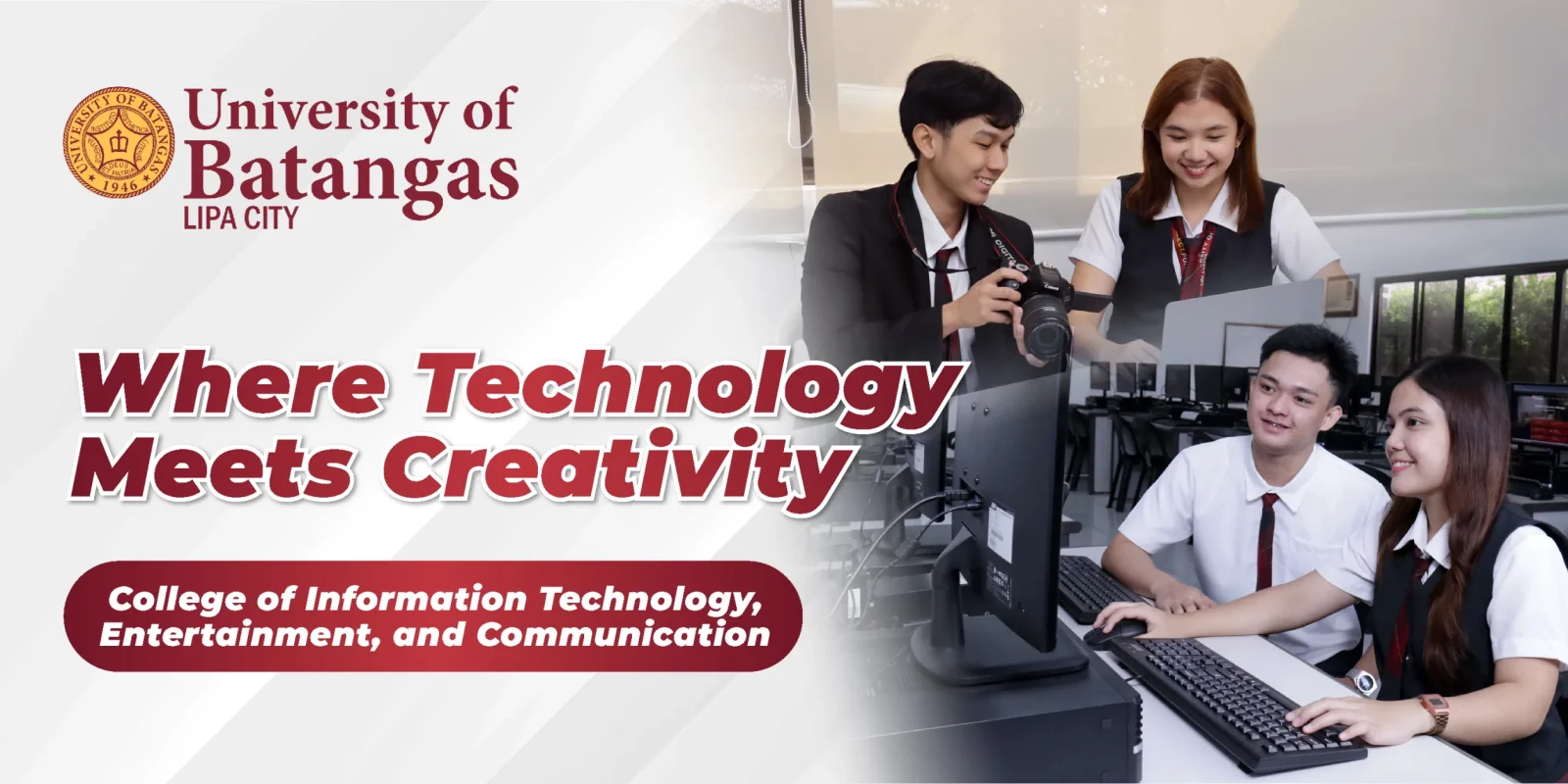
College of Information Technology, Entertainment, and Communication

CITEC

Established in 2019, the College of Information Technology, Entertainment, and Communication (CITEC) is one of the newest additions to UBLC. It originated as a small department offering the Bachelor of Science in Information Technology and played a pivotal role as one of UBLC’s pioneer programs back in 2011. The introduction of the Bachelor in Multimedia Arts program paved the way for the establishment of this thriving college.

CITEC is committed to nurturing critical thinkers, fostering research-oriented minds, and empowering individuals with creativity and innovation. We aim to shape our students into skilled professionals who can analyze complex organizational challenges, design innovative solutions, and contribute to technological advancements in the fields of information technology, entertainment, and communication.

At CITEC, we believe in unleashing the full potential of our students through experiential learning. Our dedicated and highly qualified faculty members serve as mentors, inspiring each student to achieve their best. We provide an environment conducive to learning because, at UBLC, CITEC is where technology meets creativity.

Discover boundless opportunities for growth, creativity, and technological excellence at the College of Information Technology, Entertainment, and Communication. Welcome to a dynamic learning experience!”

Mission


The College of Information Technology, Entertainment and Communication anchors its existence on the commitment to provide high quality education programs for information technology, multimedia and related technical skills through excellent instruction delivery,continuous pursuit for technological advancements and development of lifelong learners.

Vision


The College of Information Technology, Entertainment and Communication envisions to be one of the top providers of globally competitive and competent IT and multimedia professionals, as well as technically-skilled individuals who are prepared to embrace the rapidly-changing technological society.

Objectives


OBJECTIVES

• Develop a culture of excellence through advanced and specialized mentoring, observance of global standards, and adherence to the University’s core values;
• Produce holistically-developed graduates equipped with 21st century skills and competencies;
• Create a research-driven culture that inspires innovations and quest for advance knowledge.
• Utilize IT innovations that foster ethical and civic responsibility through varied community services and sustainable development programs.

COLLEGE ATTRIBUTES

C -Competent and competitive professionals
I – Innovative visionaries
TE – Technology Enthusiasts
C – Collaborative ethical leaders

Bachelor in Multimedia Arts (BMMA)is a four-year degree program designed to equip students with the knowledge and skills in multimedia design, production and development. The program covers core skills in communications, programming, graphic design, combined with digital media and the internet. It also allows students to gain conceptual, technical, aesthetic, and professional skills on all media forms, such as digital and print media, mobile content, web content and design, interactive games and content, and exhibit installations. The incorporation of application projects and internship programs in the curriculum prepares the students to real industry set-ups and practices.

NATIONAL CERTIFICATION EXAMINATION (TESDA):

• NC III ANIMATION

CAREER OPTIONS:

• Animation
• Game Development
• Public Relation
• Traditional and Digital Marketing
• Advertising
• Journalism
• Broadcasting
• Film Production
• Research

Program Educational Objectives

Program Educational Objectives (PEOs) are overarching goals that articulate what graduates of a program are expected to achieve within a few years after completing their degree. These objectives reflect the aspirations of the academic program for its students' professional and personal growth in the early stages of their careers. They serve as long-term targets that guide curriculum development and instructional strategies.
Program Outcomes, also referred to as Student Outcomes, represent the specific knowledge, skills, and abilities that students are expected to acquire by the time they graduate. These outcomes form the essential building blocks for achieving the PEOs, ensuring that graduates are well-prepared to meet the expectations set forth by the program.

In the Bachelor of Science in Information Technology (BSIT) program, the Program Educational Objectives (PEOs) and Program Outcomes (POs) are systematically embedded within course syllabi and are actively discussed by instructors during class sessions to reinforce their relevance to academic and professional development. These objectives and outcomes are also made accessible to students through the UBIAN Learning Management System (LMS), ensuring continuous visibility and alignment with the program’s educational goals.

Furthermore, they are prominently displayed on the college bulletin board to enhance awareness and accessibility for all students.

It states that three to five years after graduation, alumni in Information Technology shall have:
1. mastered the skills required for the following positions:

• Applications developer
• Database Administrator
• Entrepreneur in IT Industry
• Information Security Administrator
• Information Technology Instructor
• Network Administrator
• Network Engineer
• Systems Analyst
• Technical Support Specialist
• Test Engineer
• Web Administrator / Web Master
• Web Developer

1. demonstrated the ability to hold progressively more responsible positions in the IT field, including positions that are supervisory or managerial in nature.

2. engaged in life-long learning and professional development.

3. communicated effectively as an IT professional with users, peers, and higher management.

4. worked effectively on teams, whether as a participant or as a leader.

5. become well-rounded individuals who are productive and responsible members of society.

The BSIT program has the following as Program Outcomes:

PO1. Analyze, identify and define the requirements that must be satisfied to address problems or opportunities faced by organizations or individuals.

PO2. Design, develop and implement effective and usable IT-based solutions and integrate them into the user’s environment.

PO3. Demonstrate skills in the operation of database, networks and multimedia systems.

PO4. Apply concepts and skills in systems management and administration.

PO5. Demonstrate an ability to apply ethical behavior and professional standards to ensure computing benefits for individuals and society as a whole.

PO6. Recognize the need to engage in continuing professional development.

PO7. Communicate effectively with a range of audiences.

PO8. Work as individuals and as members of a collaborative team that solve IT problems

DEAN AND PROGRAM HEAD

Dr. Mayling Ilagan Capuno
mayling.capuno@ub.edu.ph
College Dean

Mr. Russel G. Reyes
russel.reyes@ub.edu.ph
Program Head, BSIT/BMMA Program

FACULTY AND STAFF

Dr. Kielly Chrizza Mae T. Lara
Kiellychrizzamae.tojino@ub.edu.ph

Dr. Abigail Marie U. Hernandez
abby.hernandez@ub.edu.ph

Engr. Gemma Ramos
gemma.ramos@ub.edu.ph

Mr. Aldwin Sumalabe
aldwin.sumalabe@ub.edu.ph

Mr. Jerome Delos Reyes
jerome.delosreyes@ub.edu.ph

Mr. Gabriel Paradero
gabrielvincent.paradero@ub.edu.ph

ACCREDITATIONS

Bachelor of Multimedia Arts – PACUCOA Level I Accredited

College of Information Technology, Entertainment and Communication
University of Batangas Lipa City
Marawoy Lipa City
+63 43 723-1446 local 835
citec@ub.edu.ph
Facebook Page: www.facebook.com/CITECUBLC

Bachelor of Science in Information Technology (IT)

What is a Bachelor of Science in Information Technology (IT)?

– It is an undergraduate degree program that focuses on the study of technology, computer systems, software development, and the management of information systems.

What are the core subjects in an IT program?

– Core subjects typically include programming, computer networks, database management, cyber security, software development, and information systems management.

What career opportunities are available with a Bachelor’s in IT?

– Graduates can pursue careers as software developers, network administrators, IT managers, cyber security specialists, database administrators, and more.

Do I need prior programming experience to enroll in an IT program?

– Not necessarily. Many IT programs accommodate students with varying levels of experience, from beginners to those with prior programming knowledge.

How long does it take to complete a Bachelor of Science in IT?

– It usually takes around four years of full-time study to complete a bachelor’s degree in IT.
Bachelor of Multimedia Arts

What is a Bachelor of Multimedia Arts?

– It is an undergraduate degree program that focuses on the creation and integration of various forms of digital media, including graphics, animation, video, and interactive media.

What are the core subjects in a Multimedia Arts program?

– Core subjects often include digital design, 2D and 3D animation, video production, web design, and interactive media development.

What career opportunities are available with a Bachelor’s in Multimedia Arts?

– Graduates can pursue careers as graphic designers, multimedia artists, animators, video editors, web designers, and interactive media developers.

Is a portfolio required for admission to a Multimedia Arts program?

– Some programs may require a portfolio of your creative work, while others may not. It depends on the specific requirements of the institution.

How long does it take to complete a Bachelor of Multimedia Arts?

– Typically, it takes about four years of full-time study to complete a bachelor’s degree in Multimedia Arts.

Is it necessary to have artistic skills to excel in a Multimedia Arts program?

– While having artistic skills can be an advantage, Multimedia Arts programs often provide instruction to help students develop their creative and technical skills, making it accessible to a wide range of individuals.

What software and tools are commonly used in Multimedia Arts programs?

– Commonly used software includes Adobe Creative Suite (e.g., Photoshop, Illustrator, Premiere Pro), 3D modeling software, and web development tools.
Scroll to Top