
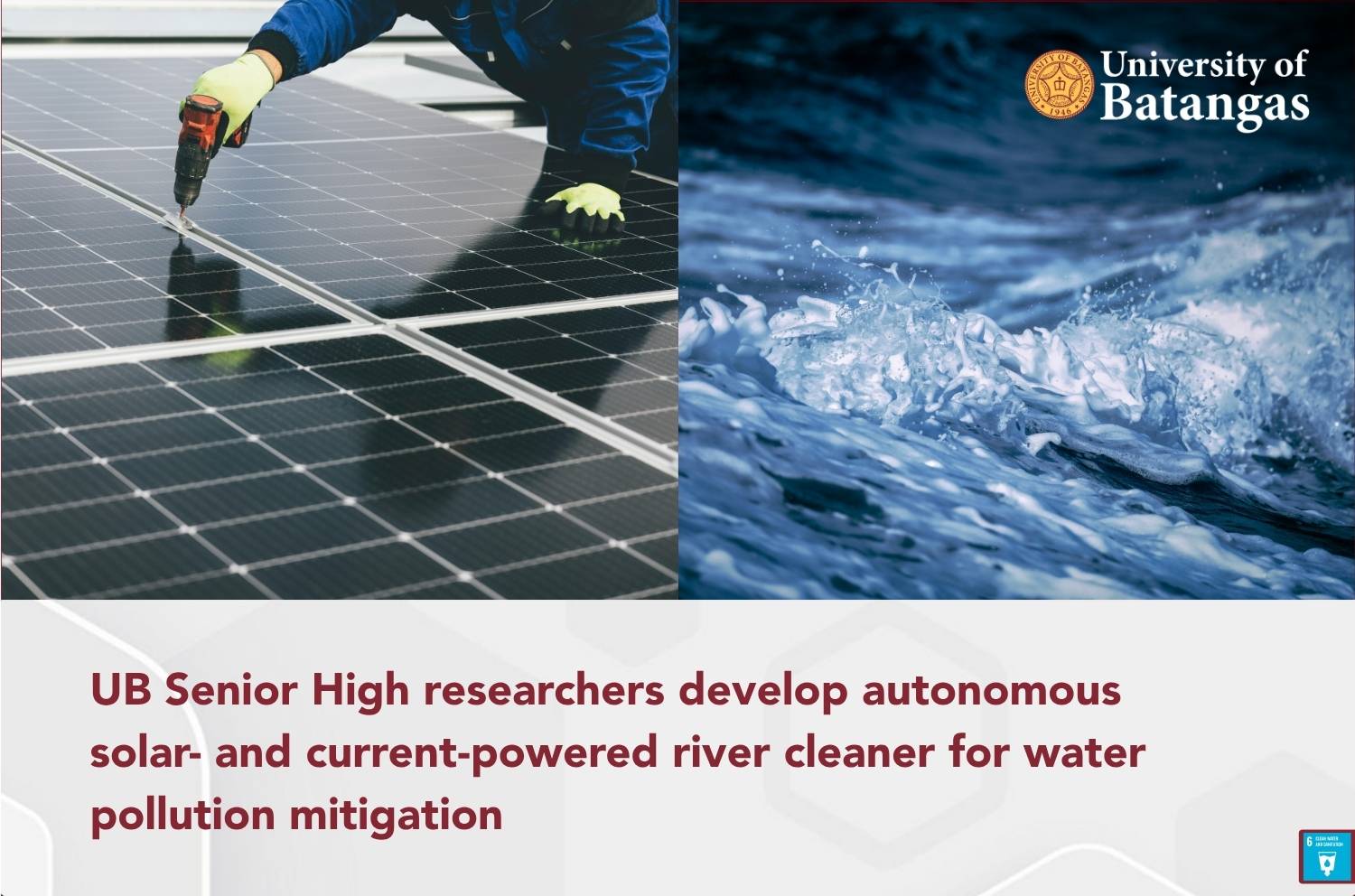
Four senior high school researchers from the University of Batangas have developed an innovative autonomous river cleaner designed to combat water pollution using renewable energy. The project, titled “SCIVER: Autonomous Solar and Current Energy Powered River Cleaner Design for Water Pollution Mitigation,” aims to address the persistent issue of river contamination in Batangas municipalities.
The team—Jade Lexer Castro, Ullrich Staniel Castro, Krisha Lee De Sagun, and Patricia Iane Mhey Macatangay—crafted a design that operates using solar power and water current energy, reducing dependence on fossil fuels while allowing continuous, autonomous operation. Their research highlights the urgent need for sustainable, long-term solutions to address the increasing volume of waste in Philippine rivers.
To ensure the technical soundness of the system, the researchers consulted electrical and electronics engineers from Batangas Province, who evaluated the design in terms of sustainability, technical structure, and maintenance requirements. The study gathered perceptions from 30 engineers, showing strong agreement that SCIVER effectively uses renewable energy sources and holds promise as an eco-friendly waste-mitigation device.
SCIVER’s design features solar panels, a water wheel for current energy capture, an air-bubble waste-guiding system, real-time monitoring sensors, and corrosion-resistant materials, allowing it to collect floating debris efficiently. Its modular structure supports easy repairs, while an alarm system alerts operators when the garbage bin reaches full capacity. Engineers noted the device’s strong sustainability features and emphasized opportunities to further enhance its adaptability and energy storage performance.
Although respondents identified areas for improvement—such as boosting energy efficiency, refining system integration, and strengthening electronic durability—they found no significant difference between the assessments of electrical and electronics engineers, underscoring a unified positive view of the system’s potential.
The study concludes that SCIVER offers a viable, scalable solution for river rehabilitation, especially in regions with rising pollution levels. It also recommends future enhancements such as advanced sensing technologies, improved battery systems, and AI-driven navigation to strengthen its performance in real-world environments.
With continued development, the autonomous cleaner may support broader efforts toward sustainable water resource management and contribute meaningfully to local environmental protection initiatives.