
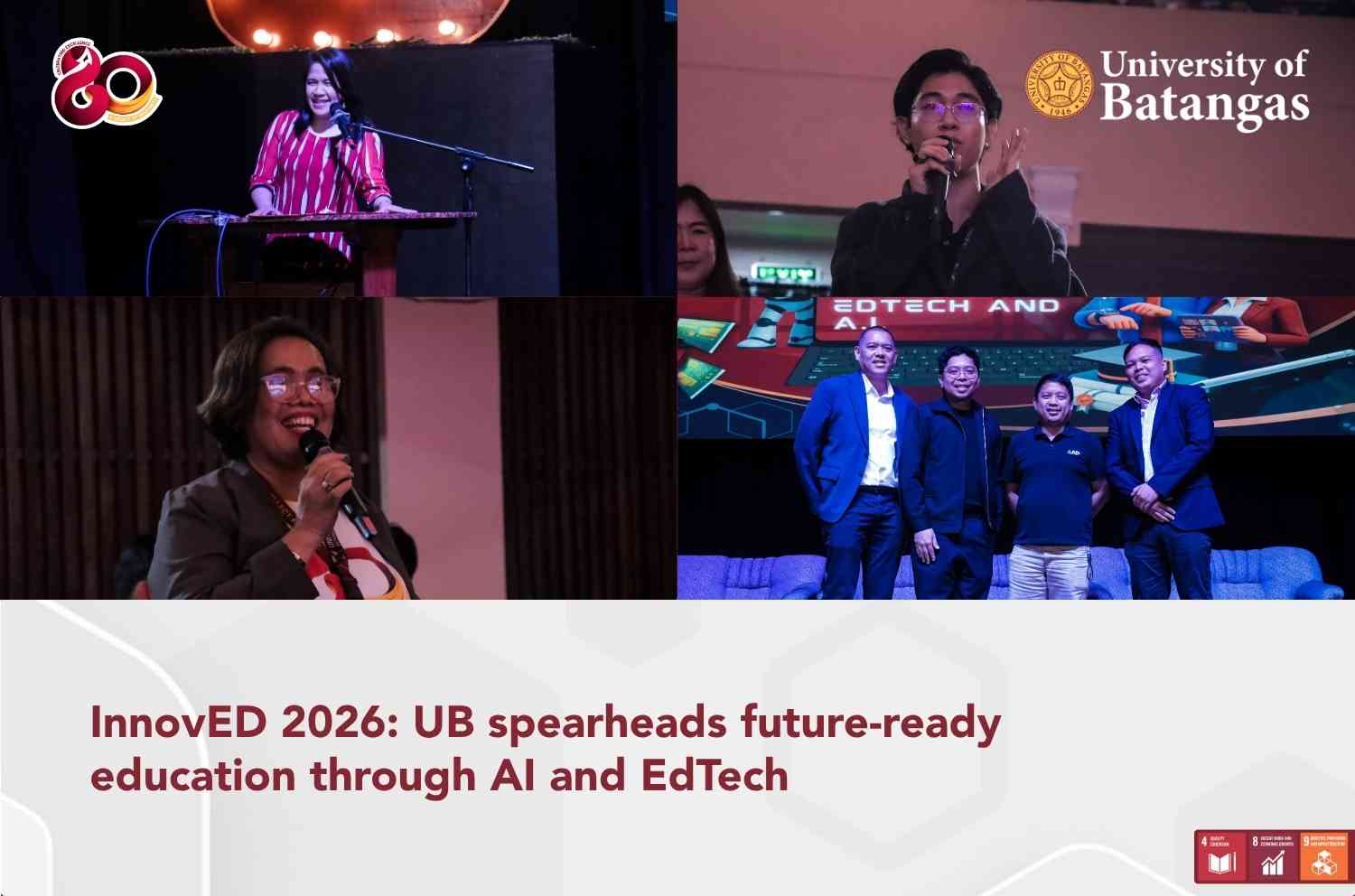
The University of Batangas (UB) took a decisive step toward the future of pedagogy as it hosted InnovED 2026: Transforming the Education Landscape through EdTech and Artificial Intelligence on March 27, 2026, held at the UB Juan Y. Javier Culture & Arts Building (UB Auditorium), gathering academic leaders and technology experts to discuss the integration of high-level digital tools in the classroom.
The UB Information Technology Center (ITC) spearheaded the event in a strategic collaboration with the College of Information and Communications Technology (CICT) and the College of Information Technology, Entertainment and Communications (CITEC). This partnership ensured a multi-disciplinary approach to the conference, merging technical expertise with academic rigor to provide a comprehensive exploration of AI’s role in the university ecosystem.
UB President Lily Marlene J. Hernandez-Bohn opened the event by connecting the institution’s 80-year legacy with the rapid shift toward a digital-first environment. She noted that while educational tools have evolved from basic DOS systems to sophisticated AI, the university’s core mission of quality remains constant. President Hernandez-Bohn urged educators to view technology as a catalyst for human connection rather than a replacement for traditional instruction.
“Innovation in education is not merely about adopting new tools, but about transforming the way we teach, learn, and connect with our students,” UB President Hernandez-Bohn asserted.
The first keynote speaker, Mr. Sherwin Pelayo, Executive Director of the Analytics and AI Association of the Philippines (AAP), presented “Bridging the Gap: AAP’s Vision for AI in the Academic Sector.” Mr. Pelayo emphasized the critical need for a unified national upskilling roadmap to maintain Philippine competitiveness. He argued that democratizing AI ensures every Filipino gains the skills to thrive regardless of their background. Mr. Pelayo reminded the audience that the true focus of the roadmap remains the empowerment of people and the promise of shared progress.
“The National AI Upskilling Roadmap is not just about technology. It is about people, purpose, and the promise of shared progress,” Mr. Pelayo underscored.
Mr. Michael Manguerra, Director of Academic Support for Instructional Services and Technology at De La Salle University (DLSU), Manila, followed with a discussion on “Teaching Excellence in the Digital Age.” Mr. Manguerra advocated for flexible learning modalities, such as HyFlex, and the strategic use of Learning Management Systems (LMS). He called for a shift toward student-centered learning that prioritizes accessibility and autonomy.
“Just give them the opportunity to learn wherever they are comfortable,” Manguerra stated, highlighting the need for education to adapt to the learner’s environment.
For the third speaker, Engr. Ericson Dimaunahan, AVP for Digital Education, Learning Technologies and Analytics at MAPUA University, addressed the necessity of leveraging analytics for student success. He framed AI fluency as a fundamental competency for the modern workforce. Engr. Dimaunahan placed the burden of responsibility on educational institutions to equip students with these tools.
“If we fail to empower our students by using these AI tools, we fail to make them succeed in the future,” Mr. Manguerra urged the university administrations to take action.
Before closing InnovED 2026, Vice President for Academic Affairs Dr. Aurora P. Tolentino delivered her closing remarks, in which she reaffirmed the university’s proactive stance, noting that UB initiated AI-related upskilling as early as 2023. She highlighted that traditional programming methods are quickly becoming relics, replaced by a synergy between human instruction and digital intelligence. Dr. Tolentino confirmed that the university will continue to prioritize faculty and employee development and upskilling in direct alignment with the university’s administrators’ vision for an AI-integrated campus.
“According to the president, this will be our faculty and employee development, upskilling, related to AI,” Dr. Tolentino shared.
The InnovED 2026 conference directly supports the global agenda for progress by adhering to several United Nations Sustainable Development Goals (SDGs). By integrating AI and EdTech, the university advances SDG 4: Quality Education to ensure inclusive and equitable learning and promote lifelong opportunities for all. Furthermore, upskilling students in AI fluency aligns with SDG 8: Decent Work and Economic Growth by preparing the future workforce for the rigorous demands of a high-tech economy and fostering productive employment. Finally, the program embodies SDG 9: Industry, Innovation, and Infrastructure as the collaboration between academia and tech associations like the AAP fosters innovation and enhances the digital infrastructure of the educational sect